


Choose how you want to study
Easy learning uses shorter English. Exam style shows the original formal wording. Both use the same answer.

Questions 1-30
Question 1
Easy learning wording
A new driver only needs the novice-driver sign if they are not confident.
See the original exam-style wording
Of the people who have only recently obtained a regular driver's license, only people who are not confident in their driving display the novice driver sign; people who are confident in their driving are not required to display it.
Exam-style wording
Of the people who have only recently obtained a regular driver's license, only people who are not confident in their driving display the novice driver sign; people who are confident in their driving are not required to display it.
Show the easier wording
A new driver only needs the novice-driver sign if they are not confident.
Answer: False
Original explanation
New drivers (licensed for less than one year) are required to display the novice driver sign regardless of their confidence.
Simpler explanation
Every driver with a regular licence for less than one year must display the novice-driver sign. Confidence does not change the rule. Remember: First year = display the novice sign.
Question 2
Easy learning wording
On a long downhill road, use the foot brake as the main brake and engine braking only as support.
See the original exam-style wording
When driving down a long downward slope, drivers of four-wheeled vehicles should mainly apply the foot brake and drivers of two-wheeled vehicles should mainly apply the brakes on the front and back wheels. Engine braking should be used as an auxiliary.
Exam-style wording
When driving down a long downward slope, drivers of four-wheeled vehicles should mainly apply the foot brake and drivers of two-wheeled vehicles should mainly apply the brakes on the front and back wheels. Engine braking should be used as an auxiliary.
Show the easier wording
On a long downhill road, use the foot brake as the main brake and engine braking only as support.
Answer: False
Original explanation
Drivers should use mainly engine braking and apply the foot brake as an auxiliary.
Simpler explanation
Use engine braking as the main way to control speed. Use the foot brake or wheel brakes as support. Remember: Select a lower gear before the long descent.
Question 3
Easy learning wording
If your vehicle breaks down on an expressway, park on a wide shoulder or side strip when possible.
See the original exam-style wording
If a driver is unavoidably forced to park on an expressway because the vehicle cannot be driven due to a breakdown, etc., the driver must park on a sufficiently wide shoulder or side strip.
Exam-style wording
If a driver is unavoidably forced to park on an expressway because the vehicle cannot be driven due to a breakdown, etc., the driver must park on a sufficiently wide shoulder or side strip.
Show the easier wording
If your vehicle breaks down on an expressway, park on a wide shoulder or side strip when possible.
Answer: True
Original explanation
Park the car in a place where it doesn't impede the progress of other vehicles.
Simpler explanation
Move the disabled vehicle as far away from moving traffic as possible, using a sufficiently wide shoulder or side strip. Remember: Protect the traffic lane first.
Question 4
Easy learning wording
If a pedestrian is crossing near an intersection with no marked crossing, slow or stop so you do not block them.
See the original exam-style wording
If a pedestrian is crossing at or near an intersection that has no pedestrian crossing, a vehicle must reduce its speed, slow down, stop, or take other precautions so as not to hinder the pedestrian's crossing.
Exam-style wording
If a pedestrian is crossing at or near an intersection that has no pedestrian crossing, a vehicle must reduce its speed, slow down, stop, or take other precautions so as not to hinder the pedestrian's crossing.
Show the easier wording
If a pedestrian is crossing near an intersection with no marked crossing, slow or stop so you do not block them.
Answer: True
Original explanation
Drivers should consider pedestrians while driving.
Simpler explanation
Drivers must protect the pedestrian and must not interfere with the crossing. Remember: No painted crossing does not remove pedestrian protection.
Question 5
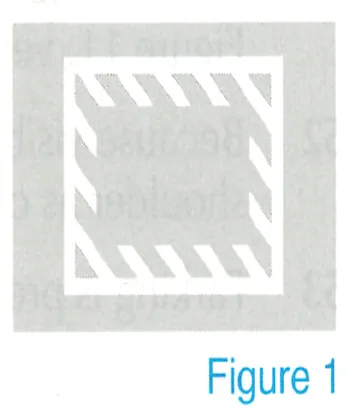
Easy learning wording
You may drive through the marked area in Figure 1, but you must not stop inside it.
See the original exam-style wording
Where there is a pavement marking as shown in Figure 1, vehicles are permitted to proceed but must not stop within it.
Exam-style wording
Where there is a pavement marking as shown in Figure 1, vehicles are permitted to proceed but must not stop within it.
Show the easier wording
You may drive through the marked area in Figure 1, but you must not stop inside it.
Answer: True
Original explanation
This marking designates a "no stopping zone" where vehicles must not stop.
Simpler explanation
The pavement marking is a no-stopping zone. Vehicles may pass through it but must not stop there. Remember: Pass through; do not stop.
Question 6
Easy learning wording
Do not give alcohol to someone who may drive later.
See the original exam-style wording
One must not offer or recommend alcohol to someone who may drive later.
Exam-style wording
One must not offer or recommend alcohol to someone who may drive later.
Show the easier wording
Do not give alcohol to someone who may drive later.
Answer: True
Original explanation
It is a crime to permit driving when intoxicated.
Simpler explanation
Helping an intoxicated person to drive is prohibited. Do not offer or recommend alcohol to a person who may drive. Remember: Alcohol and driving must be kept completely separate.
Question 7
Easy learning wording
On a dry expressway at 100 km/h, about 100 metres of following distance is needed.
See the original exam-style wording
The necessary distance between vehicles on national expressways, assuming a dry road surface and new tires, is about 100 meters at 100 km/h.
Exam-style wording
The necessary distance between vehicles on national expressways, assuming a dry road surface and new tires, is about 100 meters at 100 km/h.
Show the easier wording
On a dry expressway at 100 km/h, about 100 metres of following distance is needed.
Answer: True
Original explanation
This amount of distance between vehicles is required when considering the stopping distance.
Simpler explanation
At high speed, stopping distance is long. About 100 metres is a safe reference at 100 km/h under the stated dry-road conditions. Remember: Higher speed needs much more space.
Question 8
Easy learning wording
At a signal-controlled intersection on a road with three or more lanes each way, a general moped normally uses a two-step right turn unless signs say otherwise.
See the original exam-style wording
At intersections between roads with three or more lanes in each direction (multi-lane roads) and with traffic control, if there is no indication from traffic signs, etc., general mopeds must execute a right turn using the two-step method.
Exam-style wording
At intersections between roads with three or more lanes in each direction (multi-lane roads) and with traffic control, if there is no indication from traffic signs, etc., general mopeds must execute a right turn using the two-step method.
Show the easier wording
At a signal-controlled intersection on a road with three or more lanes each way, a general moped normally uses a two-step right turn unless signs say otherwise.
Answer: True
Original explanation
In multilane roads general mopeds, in principle, use the two-step right turn method for safety.
Simpler explanation
On this type of multi-lane road, a general moped normally follows the two-step right-turn method. Remember: Multi-lane intersection = check for the two-step moped turn.
Question 9
Easy learning wording
You must always stop behind a streetcar while passengers get on or off, even when there is a safety zone.
See the original exam-style wording
When there are passengers getting on and off a streetcar, a driver must stop until all of the passengers or other people finish crossing the road, regardless of whether there is a safety zone or not.
Exam-style wording
When there are passengers getting on and off a streetcar, a driver must stop until all of the passengers or other people finish crossing the road, regardless of whether there is a safety zone or not.
Show the easier wording
You must always stop behind a streetcar while passengers get on or off, even when there is a safety zone.
Answer: False
Original explanation
Vehicles may proceed at a low speed when passing a safety zone.
Simpler explanation
When a safety zone protects passengers, a vehicle may pass slowly. The rule is not always a complete stop. Remember: Look for a safety zone before deciding.
Question 10
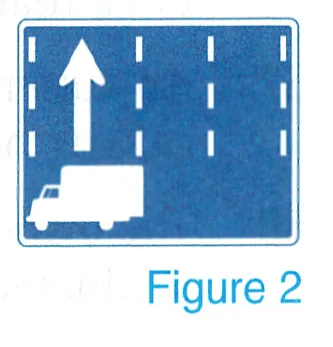
Easy learning wording
The sign in Figure 2 requires large trucks, specified medium trucks and heavy special vehicles to use the leftmost lane.
See the original exam-style wording
On a road where there is a traffic sign as shown in Figure 2, large-size trucks, specified medium trucks, and special heavy equipment must travel in the leftmost lane.
Exam-style wording
On a road where there is a traffic sign as shown in Figure 2, large-size trucks, specified medium trucks, and special heavy equipment must travel in the leftmost lane.
Show the easier wording
The sign in Figure 2 requires large trucks, specified medium trucks and heavy special vehicles to use the leftmost lane.
Answer: True
Original explanation
They must travel in the leftmost lane, in principle.
Simpler explanation
These vehicles must normally travel in the leftmost lane when this designated-lane sign applies. Remember: Match the vehicle type to the designated lane.
Question 11
Easy learning wording
A child under six does not need a child seat when sitting in the rear seat.
See the original exam-style wording
The use of a child seat is not required for a preschool child less than six years of age riding in the rear seat of a four-wheeled vehicle.
Exam-style wording
The use of a child seat is not required for a preschool child less than six years of age riding in the rear seat of a four-wheeled vehicle.
Show the easier wording
A child under six does not need a child seat when sitting in the rear seat.
Answer: False
Original explanation
The use of a child seat is required on the rear seat as well.
Simpler explanation
A child seat is required for a child under six in the rear seat as well. Remember: Rear seat does not cancel the child-seat rule.
Question 12
Easy learning wording
Centrifugal force rises with the square of speed and becomes stronger on a tighter curve.
See the original exam-style wording
Centrifugal force increases proportionally to the square of speed, and also increases as the radius of the curve decreases.
Exam-style wording
Centrifugal force increases proportionally to the square of speed, and also increases as the radius of the curve decreases.
Show the easier wording
Centrifugal force rises with the square of speed and becomes stronger on a tighter curve.
Answer: True
Original explanation
This is a law of nature (law of physics). One must be fully aware of it when driving on a curved road.
Simpler explanation
Increasing speed greatly increases outward force on a curve. A smaller curve radius also increases the force. Remember: Slow before the curve, not during it.
Question 13
Easy learning wording
When another vehicle is overtaking you, it is enough not to accelerate; you never need to move left.
See the original exam-style wording
When a driver is being overtaken by another vehicle, it is not particularly necessary for the driver to give way in their lane, as long as he or she does not accelerate, and even if there is not enough room between his or her vehicle and the vehicle in front.
Exam-style wording
When a driver is being overtaken by another vehicle, it is not particularly necessary for the driver to give way in their lane, as long as he or she does not accelerate, and even if there is not enough room between his or her vehicle and the vehicle in front.
Show the easier wording
When another vehicle is overtaking you, it is enough not to accelerate; you never need to move left.
Answer: False
Original explanation
Drivers should give way to the overtaking vehicle by moving over to the left as much as possible.
Simpler explanation
Do not accelerate, and move left as much as safely possible to help the other vehicle complete the pass. Remember: Make the overtaking manoeuvre safer, not harder.
Question 14
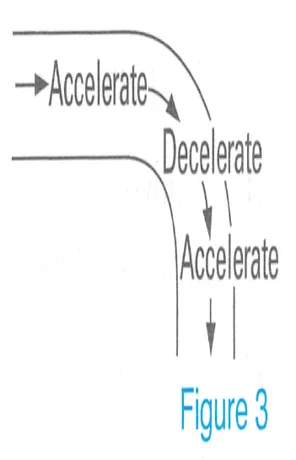
Easy learning wording
The driving line shown in Figure 3 is the correct way to take the curve.
See the original exam-style wording
The method of passing around the curve as shown in Figure 3 is correct.
Exam-style wording
The method of passing around the curve as shown in Figure 3 is correct.
Show the easier wording
The driving line shown in Figure 3 is the correct way to take the curve.
Answer: False
Original explanation
Drivers should slow down before the curve and accelerate at the end of the curve.
Simpler explanation
The shown method is not correct. Slow before entering the curve and accelerate only after the curve opens. Remember: Brake before the curve.
Question 15
Easy learning wording
If a head-on collision seems possible, keep braking and steering to reduce or avoid the impact.
See the original exam-style wording
Even when it looks as though there will be a head-on collision with an oncoming vehicle, the driver should not give up but should try to avoid the vehicle, even if just a little, by using the brake or steering wheel.
Exam-style wording
Even when it looks as though there will be a head-on collision with an oncoming vehicle, the driver should not give up but should try to avoid the vehicle, even if just a little, by using the brake or steering wheel.
Show the easier wording
If a head-on collision seems possible, keep braking and steering to reduce or avoid the impact.
Answer: True
Original explanation
A slow speed would result in less damage and increase the possibility of avoiding the collision.
Simpler explanation
Do not give up. Reducing speed or changing direction even slightly can prevent the collision or reduce the damage. Remember: Any safe reduction in speed helps.
Question 16
Easy learning wording
A motorcycle that is visible to a car driver cannot be overlooked.
See the original exam-style wording
If a two-wheeled vehicle is being driven in a position that can be seen from a four-wheeled vehicle, it won't be overlooked by the driver of the four-wheeled vehicle.
Exam-style wording
If a two-wheeled vehicle is being driven in a position that can be seen from a four-wheeled vehicle, it won't be overlooked by the driver of the four-wheeled vehicle.
Show the easier wording
A motorcycle that is visible to a car driver cannot be overlooked.
Answer: False
Original explanation
The driver of a four-wheeled vehicle might overlook a two-wheeled vehicle.
Simpler explanation
A car driver may still fail to notice a motorcycle because it is small and can be hidden in a blind spot. Remember: Visible does not always mean noticed.
Question 17
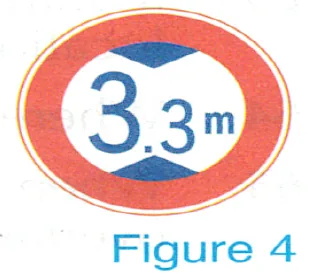
Easy learning wording
The 3.3-metre sign in Figure 4 refers only to cargo height measured from the cargo bed.
See the original exam-style wording
Where there is a traffic sign as shown in Figure 4, vehicles loaded with cargo of a height of up to 3.3 meters from the cargo bed may proceed.
Exam-style wording
Where there is a traffic sign as shown in Figure 4, vehicles loaded with cargo of a height of up to 3.3 meters from the cargo bed may proceed.
Show the easier wording
The 3.3-metre sign in Figure 4 refers only to cargo height measured from the cargo bed.
Answer: False
Original explanation
Only vehicles with a total aboveground height of up to 3.3 meters may proceed.
Simpler explanation
The limit applies to the vehicle's total height above the ground, including its cargo. Remember: Height-limit signs use total vehicle height.
Question 18
Easy learning wording
Stopping or parking is allowed in a tunnel that has traffic lanes.
See the original exam-style wording
Parking and stopping are permitted in tunnels with vehicular lanes.
Exam-style wording
Parking and stopping are permitted in tunnels with vehicular lanes.
Show the easier wording
Stopping or parking is allowed in a tunnel that has traffic lanes.
Answer: False
Original explanation
Neither parking nor stopping a vehicle is allowed in tunnels with and without vehicular lanes.
Simpler explanation
Stopping and parking are prohibited in tunnels, whether or not traffic lanes are marked. Remember: Tunnel = do not stop or park.
Question 19
Easy learning wording
Children and older pedestrians may move unexpectedly, so watch them carefully.
See the original exam-style wording
Some pedestrians such as elderly people and children behave in an unexpected manner, so drivers must carefully observe their movements.
Exam-style wording
Some pedestrians such as elderly people and children behave in an unexpected manner, so drivers must carefully observe their movements.
Show the easier wording
Children and older pedestrians may move unexpectedly, so watch them carefully.
Answer: True
Original explanation
Drivers must fully understand the characteristics of elderly people and children and prepare for an unexpected incident.
Simpler explanation
Drivers must expect unexpected movement and be ready to slow or stop. Remember: Watch the person, not only the road ahead.
Question 20
Easy learning wording
If your car breaks down on a general road in daytime, make it clearly visible with a reflector or by opening the hood or trunk.
See the original exam-style wording
When parking a regular motor vehicle on a general road in the daytime because of a breakdown, drivers should position an emergency warning reflector device or open the trunk or hood so that other drivers can see that the vehicle is broken down.
Exam-style wording
When parking a regular motor vehicle on a general road in the daytime because of a breakdown, drivers should position an emergency warning reflector device or open the trunk or hood so that other drivers can see that the vehicle is broken down.
Show the easier wording
If your car breaks down on a general road in daytime, make it clearly visible with a reflector or by opening the hood or trunk.
Answer: True
Original explanation
In order to avoid traffic accidents, it is better to clearly express that the vehicle is broken down.
Simpler explanation
Clearly show other drivers that the vehicle has broken down so they can react early. Remember: Make the hazard easy to see.
Question 21
Easy learning wording
At night on a general road, you must keep the vehicle lights on even when an emergency reflector is placed behind the car.
See the original exam-style wording
When parking or stopping a regular motor vehicle on a general road at night, even if the driver positions an emergency warning reflector device at the rear of the vehicle, he or she must turn on the hazard lights, parking lights, or tail lamps.
Exam-style wording
When parking or stopping a regular motor vehicle on a general road at night, even if the driver positions an emergency warning reflector device at the rear of the vehicle, he or she must turn on the hazard lights, parking lights, or tail lamps.
Show the easier wording
At night on a general road, you must keep the vehicle lights on even when an emergency reflector is placed behind the car.
Answer: False
Original explanation
The hazard lights, parking lights, or tail lamps are not necessary when an emergency reflector device is positioned.
Simpler explanation
Under the condition stated in this question, placing the emergency warning reflector means the listed vehicle lights are not additionally required. Remember: Read carefully whether a reflector has already been placed.
Question 22
Easy learning wording
Never lend your vehicle to an unlicensed person or to someone who has been drinking.
See the original exam-style wording
The owner of a vehicle must never lend it to a person who does not have a driver's license or to a person who has been drinking alcohol, or allow it to be taken without permission by others.
Exam-style wording
The owner of a vehicle must never lend it to a person who does not have a driver's license or to a person who has been drinking alcohol, or allow it to be taken without permission by others.
Show the easier wording
Never lend your vehicle to an unlicensed person or to someone who has been drinking.
Answer: True
Original explanation
The vehicle owner should be responsible for automobile use.
Simpler explanation
The vehicle owner must prevent unlicensed or intoxicated driving and must not allow the vehicle to be taken without permission. Remember: The owner also has responsibility.
Question 23
Easy learning wording
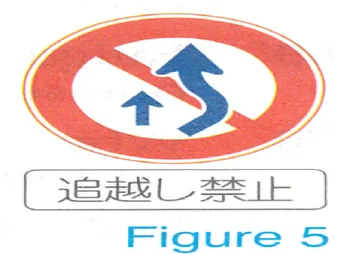
At the no-overtaking sign in Figure 5, you must not change lanes or pass to overtake.
See the original exam-style wording
Where there is a traffic sign as shown in Figure 5, vehicles must not change lanes or pass on the side in order to overtake automobiles or general mopeds.
Exam-style wording
Where there is a traffic sign as shown in Figure 5, vehicles must not change lanes or pass on the side in order to overtake automobiles or general mopeds.
Show the easier wording
At the no-overtaking sign in Figure 5, you must not change lanes or pass to overtake.
Answer: True
Original explanation
In a no overtaking zone, vehicles must not change lanes in order to overtake automobiles or mopeds.
Simpler explanation
The sign prohibits moving to the side or changing lanes for the purpose of overtaking automobiles or general mopeds. Remember: No overtaking means no passing manoeuvre around the vehicle ahead.
Question 24
Easy learning wording
The hand signal for reversing is an arm extended diagonally downward, palm facing back, moving backward.
See the original exam-style wording
The hand signal to use when reversing is as follows: signal with the arm extended diagonally downward from the vehicle and the palm facing back, waving backward.
Exam-style wording
The hand signal to use when reversing is as follows: signal with the arm extended diagonally downward from the vehicle and the palm facing back, waving backward.
Show the easier wording
The hand signal for reversing is an arm extended diagonally downward, palm facing back, moving backward.
Answer: True
Original explanation
The hand signal to be used when reversing is specified as an arm movement.
Simpler explanation
That arm movement is the specified hand signal for reversing. Remember: Use a clear backward arm motion.
Question 25
Easy learning wording
Leave more following distance on a downhill road than on level ground.
See the original exam-style wording
On a downward slope, the increase in speed causes stopping distance to become longer, so drivers should allow more distance between vehicles than when on level ground.
Exam-style wording
On a downward slope, the increase in speed causes stopping distance to become longer, so drivers should allow more distance between vehicles than when on level ground.
Show the easier wording
Leave more following distance on a downhill road than on level ground.
Answer: True
Original explanation
Drivers should allow more distance between vehicles, taking gravity influence (acceleration) into consideration.
Simpler explanation
Gravity can increase speed and lengthen stopping distance on a descent. Remember: Downhill = extra space.
Question 26
Easy learning wording
An automatic car can creep while in gear, so hold the brake and use the parking brake when stopped.
See the original exam-style wording
When an automatic transmission vehicle is stopped and the gear shift is in a position other than Ⓟ or Ⓝ, it will start to move even if the accelerator is not depressed due to the "creep" phenomenon, so the driver should engage the handbrake and firmly depress the brake pedal.
Exam-style wording
When an automatic transmission vehicle is stopped and the gear shift is in a position other than Ⓟ or Ⓝ, it will start to move even if the accelerator is not depressed due to the "creep" phenomenon, so the driver should engage the handbrake and firmly depress the brake pedal.
Show the easier wording
An automatic car can creep while in gear, so hold the brake and use the parking brake when stopped.
Answer: True
Original explanation
This is one of the characteristics of automatic transmission vehicles. Be sure to apply the brakes when the vehicle is stopped.
Simpler explanation
In a drive gear, the vehicle may move even without pressing the accelerator. Keep firm control with the brakes. Remember: In gear, assume the car may creep.
Question 27
Easy learning wording
You are completely forbidden from overtaking a vehicle showing a novice-driver or senior-driver sign.
See the original exam-style wording
Overtaking or passing a vehicle that is displaying a novice driver or senior driver sign is prohibited.
Exam-style wording
Overtaking or passing a vehicle that is displaying a novice driver or senior driver sign is prohibited.
Show the easier wording
You are completely forbidden from overtaking a vehicle showing a novice-driver or senior-driver sign.
Answer: False
Original explanation
Overtaking or passing is not prohibited, but one must not pass too close to or cut in front of the vehicle.
Simpler explanation
Overtaking itself is not completely prohibited, but you must not pass too close or cut in front of that vehicle. Remember: Give marked drivers extra space.
Question 28
Easy learning wording
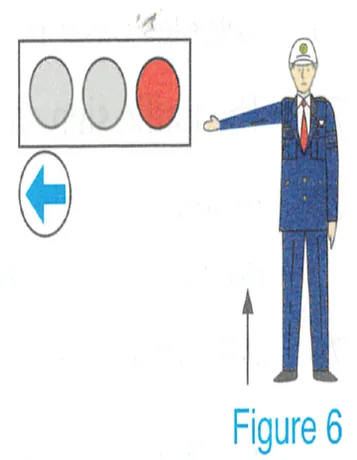
For traffic in the thin-arrow direction in Figure 6, the police hand signal means the same as the traffic signal shown.
See the original exam-style wording
For traffic proceeding in the direction of the thinner arrow as shown in Figure 6, the meaning of the police officer's hand signal and that of the traffic signal are the same.
Exam-style wording
For traffic proceeding in the direction of the thinner arrow as shown in Figure 6, the meaning of the police officer's hand signal and that of the traffic signal are the same.
Show the easier wording
For traffic in the thin-arrow direction in Figure 6, the police hand signal means the same as the traffic signal shown.
Answer: False
Original explanation
The meaning of the police officer's hand signal is the same as that of the red light but not the same as that of the arrow signal.
Simpler explanation
For that direction, the police signal has the meaning of a red light, not the arrow signal shown. Remember: Police signals take priority; read the officer's direction.
Question 29
Easy learning wording
The driver is not included in the seating capacity written on the inspection certificate.
See the original exam-style wording
The seating capacity noted on the motor vehicle inspection certificate does not include the driver.
Exam-style wording
The seating capacity noted on the motor vehicle inspection certificate does not include the driver.
Show the easier wording
The driver is not included in the seating capacity written on the inspection certificate.
Answer: False
Original explanation
The driver is included in the seating capacity.
Simpler explanation
The seating capacity includes the driver. Remember: Capacity counts everyone, including the driver.
Question 30
Easy learning wording
If you feel tired on an expressway, you may stop on a wide shoulder to rest.
See the original exam-style wording
While driving on a national expressway and the driver feels tired, he or she may enter a sufficiently wide side strip to rest.
Exam-style wording
While driving on a national expressway and the driver feels tired, he or she may enter a sufficiently wide side strip to rest.
Show the easier wording
If you feel tired on an expressway, you may stop on a wide shoulder to rest.
Answer: False
Original explanation
The side strip or shoulder of an expressway must not be used as a resting place.
Simpler explanation
An expressway shoulder is for emergencies, not ordinary rest. Use a service area or parking area. Remember: Do not use the shoulder as a rest stop.
Questions 31-60
Question 31
Easy learning wording
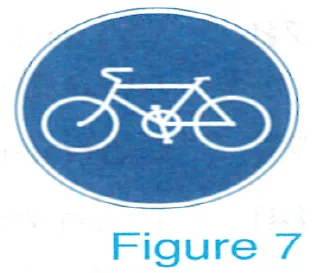
The sign in Figure 7 means a bicycle crossing.
See the original exam-style wording
The traffic sign shown in Figure 7 designates a bicycle crossing.
Exam-style wording
The traffic sign shown in Figure 7 designates a bicycle crossing.
Show the easier wording
The sign in Figure 7 means a bicycle crossing.
Answer: False
Original explanation
The sign designates a bicycle path or a dedicated road for bicycles.
Simpler explanation
It indicates a bicycle path or a road reserved for bicycles, not a bicycle crossing. Remember: Path and crossing signs are different.
Question 32
Easy learning wording
You may never place cargo on a passenger-car seat.
See the original exam-style wording
Cargo may not be loaded on the seats of a regular passenger vehicle.
Exam-style wording
Cargo may not be loaded on the seats of a regular passenger vehicle.
Show the easier wording
You may never place cargo on a passenger-car seat.
Answer: False
Original explanation
Cargo may be loaded on the seats unless it obstructs driving.
Simpler explanation
Cargo may be placed on a seat if it does not block the driver's view, controls or safe operation. Remember: Cargo is allowed only when it does not interfere with driving.
Question 33
Easy learning wording
At intersections, slow down and expect hidden dangers, pedestrians and other vehicles.
See the original exam-style wording
Intersections and their vicinity are the most dangerous and accident-prone parts of the road, so in addition to paying attention to pedestrians and other vehicles, drivers must anticipate hidden dangers in places that can't be seen and proceed at as safe a speed and manner as possible.
Exam-style wording
Intersections and their vicinity are the most dangerous and accident-prone parts of the road, so in addition to paying attention to pedestrians and other vehicles, drivers must anticipate hidden dangers in places that can't be seen and proceed at as safe a speed and manner as possible.
Show the easier wording
At intersections, slow down and expect hidden dangers, pedestrians and other vehicles.
Answer: True
Original explanation
Many traffic accidents occur at intersections. Careful attention is necessary when proceeding through intersections.
Simpler explanation
Intersections are major accident areas. Drive at a speed that lets you respond to hazards you cannot yet see. Remember: Expect what may be hidden.
Question 34
Easy learning wording
Getting a driving licence also brings serious criminal, administrative and civil responsibilities.
See the original exam-style wording
Getting a driver's license means not simply that one can drive a vehicle. One must be aware that his or her social responsibilities, such as criminal, administrative, and civil obligations, become more serious.
Exam-style wording
Getting a driver's license means not simply that one can drive a vehicle. One must be aware that his or her social responsibilities, such as criminal, administrative, and civil obligations, become more serious.
Show the easier wording
Getting a driving licence also brings serious criminal, administrative and civil responsibilities.
Answer: True
Original explanation
Those who are not aware of their responsibilities in potential accidents are not qualified as a driver.
Simpler explanation
A licence is not only permission to drive; the driver accepts important legal and social responsibilities. Remember: A licence brings responsibility.
Question 35
Easy learning wording
On a road whose left half is under 6 metres wide, with good visibility, you may cross the centre line to overtake unless signs or markings prohibit it.
See the original exam-style wording
When overtaking another vehicle on a road where the width of the left half of the road is less than 6 meters and where visibility is good, vehicles may cross the centerline into the part of the road on the right (except where prohibited by traffic signs or pavement markings).
Exam-style wording
When overtaking another vehicle on a road where the width of the left half of the road is less than 6 meters and where visibility is good, vehicles may cross the centerline into the part of the road on the right (except where prohibited by traffic signs or pavement markings).
Show the easier wording
On a road whose left half is under 6 metres wide, with good visibility, you may cross the centre line to overtake unless signs or markings prohibit it.
Answer: True
Original explanation
This is permitted as an exception to the general left-side drive rule.
Simpler explanation
This can be an exception to the normal left-side rule when the stated conditions are met. Remember: Check width, visibility and prohibition signs.
Question 36
Easy learning wording
Traffic signs and road markings tell drivers how to proceed and where to be careful.
See the original exam-style wording
Traffic signs and pavement markings inform drivers of how to proceed, points requiring caution, and other details, in order to ensure that traffic flows safely and smoothly.
Exam-style wording
Traffic signs and pavement markings inform drivers of how to proceed, points requiring caution, and other details, in order to ensure that traffic flows safely and smoothly.
Show the easier wording
Traffic signs and road markings tell drivers how to proceed and where to be careful.
Answer: True
Original explanation
Traffic signs and pavement markings inform drivers of speed, how to proceed, and other details in an easy-to-understand manner.
Simpler explanation
They communicate rules, directions, speed limits and hazards so traffic can move safely. Remember: Read signs and markings together.
Question 37
Easy learning wording
If you must brake at high speed, use engine braking and press the brake in several controlled applications.
See the original exam-style wording
When unavoidably forced to apply the brakes while driving at high speed, apply with several separate presses of the brake pedal, in addition to using the engine brake effectively.
Exam-style wording
When unavoidably forced to apply the brakes while driving at high speed, apply with several separate presses of the brake pedal, in addition to using the engine brake effectively.
Show the easier wording
If you must brake at high speed, use engine braking and press the brake in several controlled applications.
Answer: True
Original explanation
Sudden braking during high speed driving is dangerous because the vehicle loses control.
Simpler explanation
A sudden hard brake at high speed can make the vehicle unstable. Controlled braking helps maintain control. Remember: Avoid one violent brake application.
Question 38
Easy learning wording
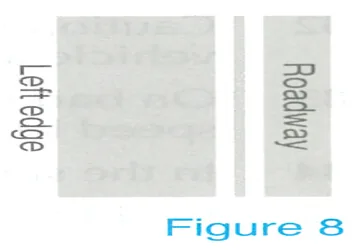
Light vehicles may use the pedestrian side strip shown in Figure 8.
See the original exam-style wording
On side strips as shown in Figure 8, light vehicles may proceed but other vehicles are not permitted to enter to park or stop.
Exam-style wording
On side strips as shown in Figure 8, light vehicles may proceed but other vehicles are not permitted to enter to park or stop.
Show the easier wording
Light vehicles may use the pedestrian side strip shown in Figure 8.
Answer: False
Original explanation
Light vehicles may not proceed because it is a side strip for pedestrians.
Simpler explanation
This side strip is for pedestrians, so light vehicles may not travel on it. Remember: A pedestrian side strip is not a vehicle lane.
Question 39
Easy learning wording
Motorcycle riders may focus too much on the road surface and miss hazards ahead or beside them.
See the original exam-style wording
Drivers of two-wheeled vehicles may be slow to detect conditions ahead of the vehicle or dangers to the side because the movement of their viewpoint, which emphasizes the road surface, narrows their field of vision.
Exam-style wording
Drivers of two-wheeled vehicles may be slow to detect conditions ahead of the vehicle or dangers to the side because the movement of their viewpoint, which emphasizes the road surface, narrows their field of vision.
Show the easier wording
Motorcycle riders may focus too much on the road surface and miss hazards ahead or beside them.
Answer: True
Original explanation
Drivers of two-wheeled vehicles should try to widen their field of vision.
Simpler explanation
A narrow field of view can delay hazard detection. Riders should consciously look farther ahead and around them. Remember: Lift your eyes and scan widely.
Question 40
Easy learning wording
Driving during a licence suspension is treated as driving without a valid licence.
See the original exam-style wording
Driving with a suspended license during the suspension period constitutes driving without a valid license.
Exam-style wording
Driving with a suspended license during the suspension period constitutes driving without a valid license.
Show the easier wording
Driving during a licence suspension is treated as driving without a valid licence.
Answer: True
Original explanation
This constitutes driving without a valid license because the suspended license is temporarily invalid.
Simpler explanation
A suspended licence is temporarily invalid, so driving during the suspension is unlicensed driving. Remember: Suspended means not valid for driving.
Question 41
Easy learning wording
When oncoming headlights dazzle you at night, stare at them until your eyes adjust.
See the original exam-style wording
At night when the lights of an oncoming vehicle are too bright, it is best to stare at them so as to quickly get used to their brightness.
Exam-style wording
At night when the lights of an oncoming vehicle are too bright, it is best to stare at them so as to quickly get used to their brightness.
Show the easier wording
When oncoming headlights dazzle you at night, stare at them until your eyes adjust.
Answer: False
Original explanation
One should move his or her gaze slightly to the left so as not to be dazzled by the lights.
Simpler explanation
Do not stare at bright headlights. Shift your gaze slightly left while keeping the road in view. Remember: Look away from the glare, not away from the road.
Question 42
Easy learning wording
Before overtaking, move very close to the vehicle ahead so the manoeuvre takes less distance.
See the original exam-style wording
When beginning to overtake a vehicle ahead, in order to finish within a short distance, a driver should move as close as possible to the vehicle and then change lanes.
Exam-style wording
When beginning to overtake a vehicle ahead, in order to finish within a short distance, a driver should move as close as possible to the vehicle and then change lanes.
Show the easier wording
Before overtaking, move very close to the vehicle ahead so the manoeuvre takes less distance.
Answer: False
Original explanation
One should avoid moving too close to the vehicle ahead and change lanes slowly.
Simpler explanation
Keep a safe gap, check the road and change lanes smoothly. Following too closely removes your safety space. Remember: Create space before you move out.
Question 43
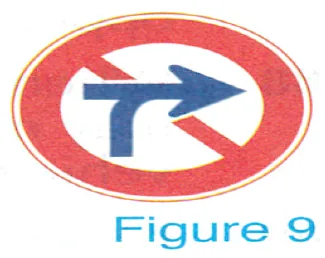
Easy learning wording
The sign in Figure 9 forbids crossing the road to enter or leave a place on the left side.
See the original exam-style wording
Where there is a traffic sign as shown in Figure 9, vehicles must not cross the road in order to enter or leave a location that is off the road on the left.
Exam-style wording
Where there is a traffic sign as shown in Figure 9, vehicles must not cross the road in order to enter or leave a location that is off the road on the left.
Show the easier wording
The sign in Figure 9 forbids crossing the road to enter or leave a place on the left side.
Answer: False
Original explanation
It is permissible to cross the road when executing a left turn in order to enter or leave a location facing the left side.
Simpler explanation
A vehicle may cross for a left turn into or out of a property on the left. The statement is too broad. Remember: The sign does not ban the stated left-side access manoeuvre.
Question 44
Easy learning wording
The safest motorcycle posture is to lean far forward to reduce wind pressure.
See the original exam-style wording
The correct riding posture for two-wheeled vehicles is slouching forward so that wind pressure decreases, making driving easy.
Exam-style wording
The correct riding posture for two-wheeled vehicles is slouching forward so that wind pressure decreases, making driving easy.
Show the easier wording
The safest motorcycle posture is to lean far forward to reduce wind pressure.
Answer: False
Original explanation
Slouching too far forward is dangerous because the viewing field becomes narrow.
Simpler explanation
Leaning too far forward narrows your view and reduces control. Use a balanced riding posture. Remember: Comfortable, balanced posture gives better control.
Question 45
Easy learning wording
After one train passes, check the opposite direction because another train may be coming.
See the original exam-style wording
When proceeding through a railway crossing, even if one train has just passed by in one direction, there may be another train approaching from the opposite direction immediately afterward. Therefore, drivers must be sure to check the safety of the opposite direction.
Exam-style wording
When proceeding through a railway crossing, even if one train has just passed by in one direction, there may be another train approaching from the opposite direction immediately afterward. Therefore, drivers must be sure to check the safety of the opposite direction.
Show the easier wording
After one train passes, check the opposite direction because another train may be coming.
Answer: True
Original explanation
Confirmation is necessary when proceeding through a multilane railway crossing.
Simpler explanation
A second train can approach immediately from the other direction, especially at a multi-track crossing. Remember: One train passing does not make the crossing safe.
Question 46
Easy learning wording
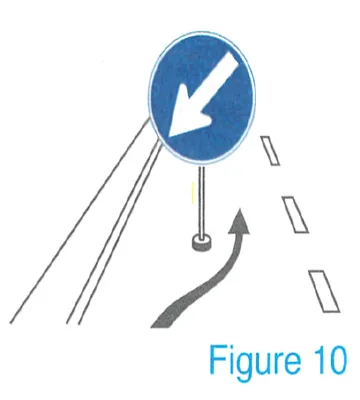
With the sign in Figure 10, follow the black arrow shown in the diagram.
See the original exam-style wording
Where there is a traffic sign as shown in Figure 10 on the road, a driver must proceed as indicated by the black arrow.
Exam-style wording
Where there is a traffic sign as shown in Figure 10 on the road, a driver must proceed as indicated by the black arrow.
Show the easier wording
With the sign in Figure 10, follow the black arrow shown in the diagram.
Answer: False
Original explanation
The driver must proceed as the traffic sign designates (on the left side).
Simpler explanation
The driver must follow the direction required by the actual traffic sign, which is the left-side direction in this figure. Remember: Follow the sign, not a misleading diagram arrow.
Question 47
Easy learning wording
Hydroplaning is the wave-shaped ripple in a tyre caused by low tyre pressure.
See the original exam-style wording
The hydroplaning phenomenon, which occurs while driving at high speed, is the wave appearing in the tire that occurs when tire pressure is low.
Exam-style wording
The hydroplaning phenomenon, which occurs while driving at high speed, is the wave appearing in the tire that occurs when tire pressure is low.
Show the easier wording
Hydroplaning is the wave-shaped ripple in a tyre caused by low tyre pressure.
Answer: False
Original explanation
Wave shaped ripples on the tire are called the standing wave phenomenon.
Simpler explanation
That tyre ripple is the standing-wave phenomenon. Hydroplaning is a different loss of tyre contact on water. Remember: Standing wave and hydroplaning are different.
Question 48
Easy learning wording
The hand signal for slowing down is the same as the hand signal for stopping.
See the original exam-style wording
The hand signal for slowing down is the same as that for stopping.
Exam-style wording
The hand signal for slowing down is the same as that for stopping.
Show the easier wording
The hand signal for slowing down is the same as the hand signal for stopping.
Answer: True
Original explanation
Both slowing down and stopping are the same signal with the arm extending diagonally downward from the vehicle.
Simpler explanation
Both use the arm extended diagonally downward from the vehicle. Remember: One signal can communicate slowing or stopping.
Question 49
Easy learning wording
If the front-right tyre has lower pressure, the steering pulls to the left.
See the original exam-style wording
If the pressure of the front right tire is lower than that of the front left tire, the steering wheel will pull to the left.
Exam-style wording
If the pressure of the front right tire is lower than that of the front left tire, the steering wheel will pull to the left.
Show the easier wording
If the front-right tyre has lower pressure, the steering pulls to the left.
Answer: False
Original explanation
The steering wheel will pull to the right because it is pulled to the side with a lower pressure tire.
Simpler explanation
The steering tends to pull toward the lower-pressure tyre, so it pulls right in this case. Remember: The car pulls toward the softer tyre.
Question 50
Easy learning wording
On a long drive, take a break at least once every two hours.
See the original exam-style wording
If driving for a long period, a driver should stop driving once every two hours and have a rest.
Exam-style wording
If driving for a long period, a driver should stop driving once every two hours and have a rest.
Show the easier wording
On a long drive, take a break at least once every two hours.
Answer: True
Original explanation
Considering the influence of fatigue, driving for two consecutive hours or longer should be avoided.
Simpler explanation
Driving for two hours or more without rest increases fatigue and reduces attention. Remember: Plan the break before you feel exhausted.
Question 51
Easy learning wording
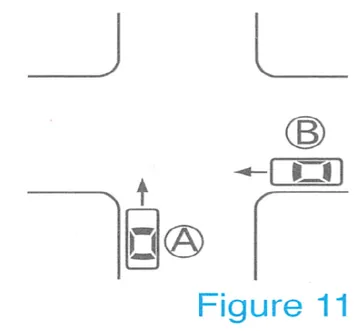
In Figure 11, vehicle A must give way to vehicle B at the equal-width uncontrolled intersection.
See the original exam-style wording
When vehicle Ⓐ and vehicle Ⓑ are approaching an intersection that has no traffic signal and the streets are the same width, as shown in Figure 11, vehicle Ⓐ may not obstruct the progress of vehicle Ⓑ.
Exam-style wording
When vehicle Ⓐ and vehicle Ⓑ are approaching an intersection that has no traffic signal and the streets are the same width, as shown in Figure 11, vehicle Ⓐ may not obstruct the progress of vehicle Ⓑ.
Show the easier wording
In Figure 11, vehicle A must give way to vehicle B at the equal-width uncontrolled intersection.
Answer: False
Original explanation
Vehicles approaching from the left have right of way, so vehicle Ⓑ may not obstruct the progress of vehicle Ⓐ.
Simpler explanation
At this equal-width uncontrolled intersection, the vehicle approaching from the left has priority. Vehicle B must not obstruct vehicle A. Remember: At equal roads, check which vehicle is coming from the left.
Question 52
Easy learning wording
In rain, drive as close as possible to the road shoulder to avoid oncoming traffic.
See the original exam-style wording
Because visibility is poor when it is raining, in order to avoid a head-on collision with an oncoming vehicle, it is best to approach the shoulder as close as possible and proceed.
Exam-style wording
Because visibility is poor when it is raining, in order to avoid a head-on collision with an oncoming vehicle, it is best to approach the shoulder as close as possible and proceed.
Show the easier wording
In rain, drive as close as possible to the road shoulder to avoid oncoming traffic.
Answer: False
Original explanation
Drivers should avoid approaching the shoulder because it becomes loose and might crumble on a rainy day.
Simpler explanation
A wet shoulder may be soft or may crumble. Keep a safe position without moving dangerously close to it. Remember: Rain makes the road edge less reliable.
Question 53
Easy learning wording
Parking is prohibited within 5 metres of a fire hydrant, firefighting-equipment storage place or fire alarm.
See the original exam-style wording
Parking is prohibited within 5 meters of a fire hydrant, a place where firefighting equipment is stored, or a fire alarm.
Exam-style wording
Parking is prohibited within 5 meters of a fire hydrant, a place where firefighting equipment is stored, or a fire alarm.
Show the easier wording
Parking is prohibited within 5 metres of a fire hydrant, firefighting-equipment storage place or fire alarm.
Answer: False
Original explanation
Parking is prohibited within 1 meter of a fire alarm.
Simpler explanation
The same 5-metre distance does not apply to every item. In the source rule, a fire alarm has a 1-metre no-parking zone. Remember: Do not apply one distance to every firefighting facility.
Question 54
Easy learning wording
To turn right on a normal two-way road, move close to the right edge before the turn.
See the original exam-style wording
When executing a right turn, the automobile must initially approach the right edge of the road as closely as possible and slow down immediately inside the center point of the intersection. (Except roundabout.)
Exam-style wording
When executing a right turn, the automobile must initially approach the right edge of the road as closely as possible and slow down immediately inside the center point of the intersection. (Except roundabout.)
Show the easier wording
To turn right on a normal two-way road, move close to the right edge before the turn.
Answer: False
Original explanation
Automobiles must approach the center of the road when not driving on a one-way street.
Simpler explanation
Except on a one-way road, approach near the centre of the road and turn slowly around the centre of the intersection. Remember: Two-way road right turn = approach the centre.
Question 55
Easy learning wording
At a flashing red signal, you may either stop or simply slow down.
See the original exam-style wording
When the traffic signal is a flashing red light, vehicles must stop or slow down.
Exam-style wording
When the traffic signal is a flashing red light, vehicles must stop or slow down.
Show the easier wording
At a flashing red signal, you may either stop or simply slow down.
Answer: False
Original explanation
Vehicles must stop. Slowing down is not an option.
Simpler explanation
A flashing red signal requires a complete stop before proceeding safely. Remember: Flashing red = stop.
Question 56
Easy learning wording
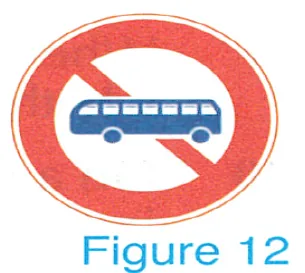
With the sign in Figure 12, a passenger vehicle carrying 10 people may proceed.
See the original exam-style wording
Where there is a traffic sign as shown in Figure 12, a passenger vehicle with 10 passengers may proceed.
Exam-style wording
Where there is a traffic sign as shown in Figure 12, a passenger vehicle with 10 passengers may proceed.
Show the easier wording
With the sign in Figure 12, a passenger vehicle carrying 10 people may proceed.
Answer: True
Original explanation
The traffic sign shows that the road is closed to passenger vehicles with a capacity of 11 passengers or more.
Simpler explanation
The restriction applies to passenger vehicles with a capacity of 11 or more, so the stated 10-passenger vehicle may proceed. Remember: Read the vehicle-capacity threshold.
Question 57
Easy learning wording
While cargo is being loaded, you may stop for ten minutes with the driver beside the car and ready to move it, even if less than 3.5 metres remains.
See the original exam-style wording
An automobile may stop for ten minutes on a road where there is less than 3.5 meters of space between the right side of the vehicle and the right side of the road while the driver stands beside the vehicle and gives instructions for the loading of cargo.
Exam-style wording
An automobile may stop for ten minutes on a road where there is less than 3.5 meters of space between the right side of the vehicle and the right side of the road while the driver stands beside the vehicle and gives instructions for the loading of cargo.
Show the easier wording
While cargo is being loaded, you may stop for ten minutes with the driver beside the car and ready to move it, even if less than 3.5 metres remains.
Answer: True
Original explanation
Drivers are allowed to park when loading or unloading cargo and the driver is immediately available to drive.
Simpler explanation
Under the conditions stated, this is treated as loading activity with the driver immediately available, not ordinary unattended parking. Remember: The driver's immediate availability is important.
Question 58
Easy learning wording
Your off-road parking place may be up to 5 kilometres from the vehicle's usual base.
See the original exam-style wording
The owner of an automobile (excluding two-wheeled motor vehicles) must obtain a personal parking place for it that is not on a road and is within 5 kilometers of the address or other base position from which the automobile will be used.
Exam-style wording
The owner of an automobile (excluding two-wheeled motor vehicles) must obtain a personal parking place for it that is not on a road and is within 5 kilometers of the address or other base position from which the automobile will be used.
Show the easier wording
Your off-road parking place may be up to 5 kilometres from the vehicle's usual base.
Answer: False
Original explanation
The personal parking place must be within 2 km.
Simpler explanation
The required parking place must be within 2 kilometres of the vehicle's base position. Remember: Remember 2 km, not 5 km.
Question 59
Easy learning wording
If the vehicle behind has begun overtaking you, cancel your own attempt to overtake the vehicle ahead.
See the original exam-style wording
If the driver notices that the vehicle behind is attempting to overtake the driver's own vehicle, when intending to overtake the vehicle ahead and checking for safety, he or she should give up the attempt to overtake the vehicle ahead.
Exam-style wording
If the driver notices that the vehicle behind is attempting to overtake the driver's own vehicle, when intending to overtake the vehicle ahead and checking for safety, he or she should give up the attempt to overtake the vehicle ahead.
Show the easier wording
If the vehicle behind has begun overtaking you, cancel your own attempt to overtake the vehicle ahead.
Answer: True
Original explanation
As dangerous overtaking is prohibited, giving up the attempt to overtake is right for safety reasons.
Simpler explanation
Two vehicles trying to overtake at the same time creates danger. Let the vehicle behind complete its manoeuvre. Remember: Do not start a competing overtake.
Question 60
Easy learning wording
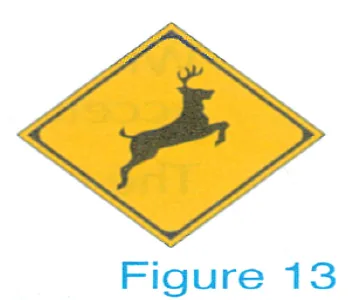
The sign in Figure 13 warns that animals may suddenly enter the road.
See the original exam-style wording
The traffic sign in Figure 13 indicates that there is a danger of animals appearing suddenly on the road.
Exam-style wording
The traffic sign in Figure 13 indicates that there is a danger of animals appearing suddenly on the road.
Show the easier wording
The sign in Figure 13 warns that animals may suddenly enter the road.
Answer: True
Original explanation
This is a warning sign to indicate that there is a danger of animals appearing suddenly on the road.
Simpler explanation
It is an animal-crossing warning sign. Reduce speed and watch the roadside. Remember: Animals may appear without warning.
Questions 61-90
Question 61
Easy learning wording
If you become even slightly sleepy at night, stop safely and rest before continuing.
See the original exam-style wording
If drivers feel even slightly sleepy while driving at night, they should stop the vehicle in a safe location and take a nap or rest for a short time, resuming driving after they feel refreshed.
Exam-style wording
If drivers feel even slightly sleepy while driving at night, they should stop the vehicle in a safe location and take a nap or rest for a short time, resuming driving after they feel refreshed.
Show the easier wording
If you become even slightly sleepy at night, stop safely and rest before continuing.
Answer: True
Original explanation
One should not put up with drowsiness but should relieve drowsiness before resuming driving.
Simpler explanation
Do not try to endure drowsiness. Resume only after you are alert again. Remember: Sleepiness is a stop signal.
Question 62
Easy learning wording
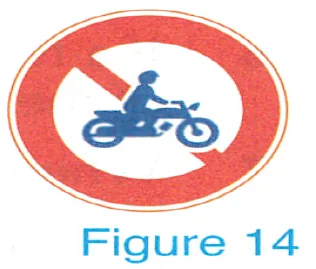
The sign in Figure 14 bans large and regular motorcycles, but general mopeds may continue.
See the original exam-style wording
On a road where there is a traffic sign as shown in Figure 14, large-size and regular motorcycles may not proceed, but general mopeds may proceed.
Exam-style wording
On a road where there is a traffic sign as shown in Figure 14, large-size and regular motorcycles may not proceed, but general mopeds may proceed.
Show the easier wording
The sign in Figure 14 bans large and regular motorcycles, but general mopeds may continue.
Answer: False
Original explanation
General mopeds may not proceed either.
Simpler explanation
General mopeds are also prohibited by this sign. Remember: The prohibition includes mopeds.
Question 63
Easy learning wording
After an expressway breakdown, place the warnings, leave the vehicle and wait in a safe location.
See the original exam-style wording
If unavoidably forced to park on an expressway due to a breakdown, the driver (and any passengers) should leave the vehicle and move to a safe location after completing the necessary measures to prevent a collision.
Exam-style wording
If unavoidably forced to park on an expressway due to a breakdown, the driver (and any passengers) should leave the vehicle and move to a safe location after completing the necessary measures to prevent a collision.
Show the easier wording
After an expressway breakdown, place the warnings, leave the vehicle and wait in a safe location.
Answer: True
Original explanation
It is safer to leave the vehicle and wait somewhere else because there is a danger of a collision with a parked vehicle.
Simpler explanation
Remaining in or beside a stopped vehicle exposes you to a high-speed collision. Move behind a barrier or to another safe place. Remember: Warn traffic, then move yourself to safety.
Question 64
Easy learning wording
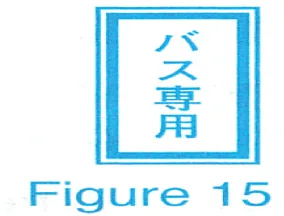
Only buses may follow the special signal shown with the signboard in Figure 15.
See the original exam-style wording
Where there is a signboard as shown in Figure 15, only buses may follow the traffic signal indicated by the signboard.
Exam-style wording
Where there is a signboard as shown in Figure 15, only buses may follow the traffic signal indicated by the signboard.
Show the easier wording
Only buses may follow the special signal shown with the signboard in Figure 15.
Answer: True
Original explanation
The signboard is used to indicate that the signal is placed for the smooth flow of bus traffic.
Simpler explanation
The special signal is provided to control bus movement and improve bus traffic flow. Remember: A bus-only signal is not for ordinary vehicles.
Question 65
Easy learning wording
While overtaking, you may sound the horn if the vehicle ahead starts moving right and danger is developing.
See the original exam-style wording
When a vehicle attempts to overtake the vehicle ahead, the vehicle ahead may not notice and begin to change to the right lane. If the driver of the overtaking vehicle senses danger, he or she may sound the horn.
Exam-style wording
When a vehicle attempts to overtake the vehicle ahead, the vehicle ahead may not notice and begin to change to the right lane. If the driver of the overtaking vehicle senses danger, he or she may sound the horn.
Show the easier wording
While overtaking, you may sound the horn if the vehicle ahead starts moving right and danger is developing.
Answer: True
Original explanation
The horn can be used when needed to avoid danger.
Simpler explanation
The horn may be used when it is necessary to avoid immediate danger. Remember: Use the horn for danger, not impatience.
Question 66
Easy learning wording
Worn tyres increase braking distance but do not change reaction distance.
See the original exam-style wording
When tires wear down, the frictional resistance between the road surface and the tires decreases. Braking distance increases but reaction distance is not affected.
Exam-style wording
When tires wear down, the frictional resistance between the road surface and the tires decreases. Braking distance increases but reaction distance is not affected.
Show the easier wording
Worn tyres increase braking distance but do not change reaction distance.
Answer: True
Original explanation
The reaction distance has nothing to do with worn tires because the brakes don't start to operate at the reaction distance.
Simpler explanation
Tyre condition affects grip and braking distance. Reaction distance happens before the brakes begin working, so tyre wear does not change it. Remember: Reaction first, braking second.
Question 67
Easy learning wording
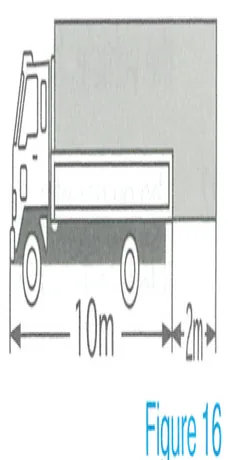
For the overhanging indivisible cargo in Figure 16, no police permit is needed.
See the original exam-style wording
If loading cargo that cannot be divided as shown in Figure 16, a driver need not obtain a permit from the police chief having jurisdiction over the place of departure.
Exam-style wording
If loading cargo that cannot be divided as shown in Figure 16, a driver need not obtain a permit from the police chief having jurisdiction over the place of departure.
Show the easier wording
For the overhanging indivisible cargo in Figure 16, no police permit is needed.
Answer: False
Original explanation
A permit must be obtained because the total length extends beyond more than 1/10th of the length behind the automobile.
Simpler explanation
A permit is required because the cargo extends beyond the permitted vehicle length. Remember: Oversize cargo may require permission.
Question 68
Easy learning wording
An inspection sticker shows when the vehicle inspection was completed.
See the original exam-style wording
An inspection sticker indicates the month and year in which the inspection was made.
Exam-style wording
An inspection sticker indicates the month and year in which the inspection was made.
Show the easier wording
An inspection sticker shows when the vehicle inspection was completed.
Answer: False
Original explanation
They indicate the next inspection timing (year, month).
Simpler explanation
It shows the timing of the next required inspection, not the date of the last inspection. Remember: Sticker = next inspection due.
Question 69
Easy learning wording
Driving fatigue often first appears in the eyes and causes missed hazards, visual mistakes and poorer judgement.
See the original exam-style wording
Fatigue and its effects while driving are shown most strongly in the eyes; incidences of failing to notice something or mistaking what one sees become more frequent and the driver's sense of judgment deteriorates.
Exam-style wording
Fatigue and its effects while driving are shown most strongly in the eyes; incidences of failing to notice something or mistaking what one sees become more frequent and the driver's sense of judgment deteriorates.
Show the easier wording
Driving fatigue often first appears in the eyes and causes missed hazards, visual mistakes and poorer judgement.
Answer: True
Original explanation
Fatigue and its effects are most evident in the eyes because of their heavy usage while driving.
Simpler explanation
The eyes work continuously while driving, so fatigue can quickly damage observation and decision-making. Remember: Tired eyes mean poorer decisions.
Question 70
Easy learning wording
Turn on the lights in a tunnel or thick fog when you cannot see 50 metres ahead, even in daytime.
See the original exam-style wording
When proceeding in a place such as a tunnel or in thick fog that inhibits one's ability to see 50 meters ahead (200 meters on an expressway), the lights must be turned on, even in the daytime.
Exam-style wording
When proceeding in a place such as a tunnel or in thick fog that inhibits one's ability to see 50 meters ahead (200 meters on an expressway), the lights must be turned on, even in the daytime.
Show the easier wording
Turn on the lights in a tunnel or thick fog when you cannot see 50 metres ahead, even in daytime.
Answer: True
Original explanation
The purpose of headlights is not only to maintain the range of vision but also to warn other drivers of the presence of a vehicle.
Simpler explanation
Lights help you see and also help other road users see your vehicle. The expressway visibility distance in the question is 200 metres. Remember: Lights are for being seen as well as seeing.
Question 71
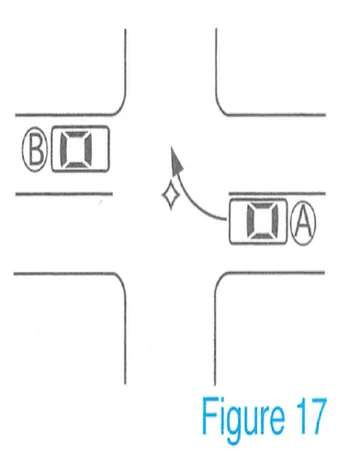
Easy learning wording
In Figure 17, a vehicle already waiting to turn right may go before an oncoming vehicle that is turning left.
See the original exam-style wording
In the situation shown in Figure 17, vehicle Ⓐ has entered the intersection first intending to execute a right turn. If vehicle Ⓑ proceeds straight through, vehicle Ⓐ must wait inside the intersection until it passes, but if vehicle Ⓑ is executing a left turn, vehicle Ⓐ may go ahead and execute a right turn.
Exam-style wording
In the situation shown in Figure 17, vehicle Ⓐ has entered the intersection first intending to execute a right turn. If vehicle Ⓑ proceeds straight through, vehicle Ⓐ must wait inside the intersection until it passes, but if vehicle Ⓑ is executing a left turn, vehicle Ⓐ may go ahead and execute a right turn.
Show the easier wording
In Figure 17, a vehicle already waiting to turn right may go before an oncoming vehicle that is turning left.
Answer: False
Original explanation
Vehicles executing right turns must not obstruct the progress of oncoming straight-through traffic and vehicles executing left turns.
Simpler explanation
A right-turning vehicle must not obstruct oncoming vehicles going straight or turning left. Remember: Right turn gives way to oncoming straight and left traffic.
Question 72
Easy learning wording
At a signal-controlled intersection with no stop line, stop immediately before the traffic signal.
See the original exam-style wording
At intersections with a traffic signal but no stop line, the correct position to stop is immediately before the traffic signal.
Exam-style wording
At intersections with a traffic signal but no stop line, the correct position to stop is immediately before the traffic signal.
Show the easier wording
At a signal-controlled intersection with no stop line, stop immediately before the traffic signal.
Answer: False
Original explanation
Vehicles should stop immediately before the intersection, not immediately before the traffic signal.
Simpler explanation
Stop immediately before the intersection, not simply beneath or before the signal unit. Remember: No stop line = stop before entering the intersection.
Question 73
Easy learning wording
Only large trucks carrying cargo may use an expressway's slower-traffic lane.
See the original exam-style wording
Vehicles other than large-size trucks loaded with cargo may not use the slower traffic lane of an expressway.
Exam-style wording
Vehicles other than large-size trucks loaded with cargo may not use the slower traffic lane of an expressway.
Show the easier wording
Only large trucks carrying cargo may use an expressway's slower-traffic lane.
Answer: False
Original explanation
Any vehicles that cannot satisfy the minimum speed limit are allowed to use it.
Simpler explanation
Other vehicles that cannot meet the minimum speed may also use the slower lane. Remember: The slow lane is based on operating speed, not only vehicle type.
Question 74
Easy learning wording
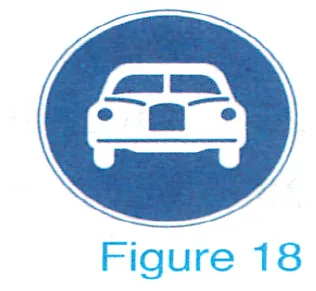
The sign in Figure 18 designates an expressway or motorway for motor vehicles.
See the original exam-style wording
The traffic sign shown in Figure 18 designates a national expressway or a motorway.
Exam-style wording
The traffic sign shown in Figure 18 designates a national expressway or a motorway.
Show the easier wording
The sign in Figure 18 designates an expressway or motorway for motor vehicles.
Answer: True
Original explanation
This is a sign designating motor vehicles only, and is placed on a national expressway or a motorway.
Simpler explanation
It is the motor-vehicles-only sign used on national expressways or motorways. Remember: No pedestrians, bicycles or other excluded traffic.
Question 75
Easy learning wording
If impact speed is cut in half, the collision energy becomes about one quarter.
See the original exam-style wording
When a vehicle collides with an object at rest, if it can decrease its speed to half, the kinetic energy at the time of impact will be just about one-quarter of that generated when speed is not decreased.
Exam-style wording
When a vehicle collides with an object at rest, if it can decrease its speed to half, the kinetic energy at the time of impact will be just about one-quarter of that generated when speed is not decreased.
Show the easier wording
If impact speed is cut in half, the collision energy becomes about one quarter.
Answer: True
Original explanation
The kinetic energy at the time of a collision is proportional to the square of speed. 1/2 × 1/2 = 1/4.
Simpler explanation
Kinetic energy changes with the square of speed: one half times one half equals one quarter. Remember: A small speed reduction makes a large energy reduction.
Question 76
Easy learning wording
When the parking brake is pulled fully, there should be no remaining movement at all.
See the original exam-style wording
When the hand brake of a four-wheeled vehicle is pulled all the way, there should not be any room to pull it further.
Exam-style wording
When the hand brake of a four-wheeled vehicle is pulled all the way, there should not be any room to pull it further.
Show the easier wording
When the parking brake is pulled fully, there should be no remaining movement at all.
Answer: False
Original explanation
There should be room to pull it further. Otherwise the brake doesn't operate well.
Simpler explanation
The parking brake should have some reserve travel. No reserve can indicate poor adjustment or operation. Remember: A correctly adjusted brake still has specified travel.
Question 77
Easy learning wording
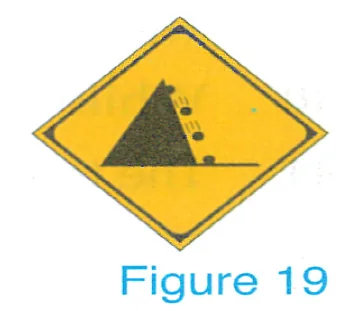
The sign in Figure 19 warns that the road shoulder may crumble.
See the original exam-style wording
The traffic sign in Figure 19 warns drivers that the shoulder crumbles easily.
Exam-style wording
The traffic sign in Figure 19 warns drivers that the shoulder crumbles easily.
Show the easier wording
The sign in Figure 19 warns that the road shoulder may crumble.
Answer: False
Original explanation
This sign warns of falling rocks.
Simpler explanation
This sign warns about falling rocks. Remember: Look above and along the roadside for falling-rock danger.
Question 78
Easy learning wording
There is about one second between noticing danger and the brakes beginning to work.
See the original exam-style wording
When the brake is applied in response to danger, there is about 1 second of reaction time until the brake begins to take effect, so drivers must take this into consideration when driving.
Exam-style wording
When the brake is applied in response to danger, there is about 1 second of reaction time until the brake begins to take effect, so drivers must take this into consideration when driving.
Show the easier wording
There is about one second between noticing danger and the brakes beginning to work.
Answer: True
Original explanation
Drivers should be aware of reaction time while driving so as to react safely should danger arise.
Simpler explanation
That reaction time creates reaction distance before braking starts, so leave enough space. Remember: You travel before the brake takes effect.
Question 79
Easy learning wording
At a corner, overtaking is prohibited and you must slow down.
See the original exam-style wording
Corners are places where overtaking is prohibited and drivers must slow down.
Exam-style wording
Corners are places where overtaking is prohibited and drivers must slow down.
Show the easier wording
At a corner, overtaking is prohibited and you must slow down.
Answer: True
Original explanation
Corners are dangerous locations where drivers must not overtake others and must slow down.
Simpler explanation
Corners hide traffic and reduce control, so overtaking is prohibited and reduced speed is required. Remember: Hidden road ahead = slow, no overtaking.
Question 80
Easy learning wording
When an emergency vehicle approaches an intersection, clear the intersection, move left and stop, except where the one-way-road rule applies.
See the original exam-style wording
If an emergency vehicle is at or near an intersection, vehicles must clear the intersection, move to the left side of the road, and come to a stop (except for one-way streets).
Exam-style wording
If an emergency vehicle is at or near an intersection, vehicles must clear the intersection, move to the left side of the road, and come to a stop (except for one-way streets).
Show the easier wording
When an emergency vehicle approaches an intersection, clear the intersection, move left and stop, except where the one-way-road rule applies.
Answer: True
Original explanation
Vehicles must let the emergency vehicle proceed in any direction at an intersection.
Simpler explanation
Do not stop inside the intersection. Make room so the emergency vehicle can choose its route. Remember: Clear the intersection first.
Question 81
Easy learning wording
Keep the inspection certificate and compulsory insurance document safely at home while driving.
See the original exam-style wording
The motor vehicle inspection certificate and a compulsory automobile liability insurance form (including a mutual relief system insurance certificate) are important documents, so in order to prevent loss or theft when driving one's automobile, it is best to store them carefully in one's home separately from the vehicle.
Exam-style wording
The motor vehicle inspection certificate and a compulsory automobile liability insurance form (including a mutual relief system insurance certificate) are important documents, so in order to prevent loss or theft when driving one's automobile, it is best to store them carefully in one's home separately from the vehicle.
Show the easier wording
Keep the inspection certificate and compulsory insurance document safely at home while driving.
Answer: False
Original explanation
One must keep them in the vehicle while driving.
Simpler explanation
These documents must be carried in the vehicle while it is being driven. Remember: Required vehicle documents stay with the vehicle.
Question 82
Easy learning wording
A motorcycle passing a car can enter the car's blind spot and may not be noticed.
See the original exam-style wording
Caution is required when a two-wheeled vehicle passes a four-wheeled vehicle, because the two-wheeled vehicle may enter the blind spot of the four-wheeled vehicle and its driver may not be aware of the existence of the two-wheeled vehicle.
Exam-style wording
Caution is required when a two-wheeled vehicle passes a four-wheeled vehicle, because the two-wheeled vehicle may enter the blind spot of the four-wheeled vehicle and its driver may not be aware of the existence of the two-wheeled vehicle.
Show the easier wording
A motorcycle passing a car can enter the car's blind spot and may not be noticed.
Answer: True
Original explanation
A two-wheeled vehicle tends to be overlooked in the blind spot of the rearview mirror of a four-wheeled vehicle.
Simpler explanation
Motorcycles are small and can disappear from mirrors. Both riders and drivers must check blind spots. Remember: Do not stay beside a vehicle where the driver cannot see you.
Question 83
Easy learning wording
On mud or gravel, slow down early and avoid sudden acceleration, braking or steering.
See the original exam-style wording
On bad road surfaces such as mud or gravel, it is easy for the steering wheel to pull or the tires to slip, so the driver should reduce speed in advance and must not suddenly accelerate, brake, or swerve.
Exam-style wording
On bad road surfaces such as mud or gravel, it is easy for the steering wheel to pull or the tires to slip, so the driver should reduce speed in advance and must not suddenly accelerate, brake, or swerve.
Show the easier wording
On mud or gravel, slow down early and avoid sudden acceleration, braking or steering.
Answer: True
Original explanation
Sudden operations are dangerous and should be avoided, particularly on bad road surfaces.
Simpler explanation
Low and uneven grip makes abrupt controls more likely to cause a skid or loss of steering. Remember: Smooth controls protect traction.
Question 84
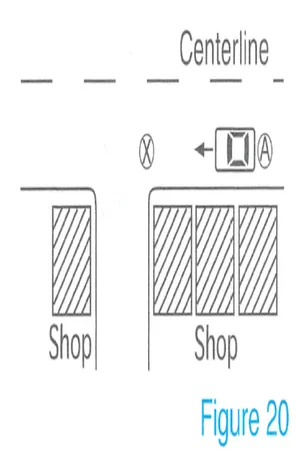
Easy learning wording
In Figure 20, vehicle A must slow down at point X.
See the original exam-style wording
In the situation shown in Figure 20, when vehicle Ⓐ passes the point indicated by Ⓧ, it must slow down.
Exam-style wording
In the situation shown in Figure 20, when vehicle Ⓐ passes the point indicated by Ⓧ, it must slow down.
Show the easier wording
In Figure 20, vehicle A must slow down at point X.
Answer: False
Original explanation
Vehicle Ⓐ doesn't have to slow down because it has the right of way.
Simpler explanation
Vehicle A has the right of way in the shown situation, so the statement that it must slow at X is false. Remember: Identify the priority road before answering.
Question 85
Easy learning wording
A small coolant or oil leak is not a breakdown, so you may continue driving.
See the original exam-style wording
If a little coolant or oil is leaking under the vehicle, that is not a mechanical breakdown, so the vehicle may be driven.
Exam-style wording
If a little coolant or oil is leaking under the vehicle, that is not a mechanical breakdown, so the vehicle may be driven.
Show the easier wording
A small coolant or oil leak is not a breakdown, so you may continue driving.
Answer: False
Original explanation
The leakage of coolant or oil is a mechanical breakdown that requires repair.
Simpler explanation
A coolant or oil leak is a mechanical problem that needs inspection and repair. Remember: A small leak can become a major failure.
Question 86
Easy learning wording
During congestion, automobiles and general mopeds may use the side strip to keep moving.
See the original exam-style wording
When the road is congested, automobiles and general mopeds may enter the side strip and proceed.
Exam-style wording
When the road is congested, automobiles and general mopeds may enter the side strip and proceed.
Show the easier wording
During congestion, automobiles and general mopeds may use the side strip to keep moving.
Answer: False
Original explanation
Automobiles and mopeds may not enter the side strip or the sidewalk.
Simpler explanation
Automobiles and mopeds must not drive on the side strip or sidewalk to bypass congestion. Remember: Congestion does not create an extra lane.
Question 87
Easy learning wording
Do not cut between vehicles queued at an intersection or railway crossing.
See the original exam-style wording
When vehicles are proceeding in succession, if vehicles ahead are stopped at an intersection or railway crossing, or slowing down, vehicles must not take this opportunity to cut in between vehicles or cross in front of them.
Exam-style wording
When vehicles are proceeding in succession, if vehicles ahead are stopped at an intersection or railway crossing, or slowing down, vehicles must not take this opportunity to cut in between vehicles or cross in front of them.
Show the easier wording
Do not cut between vehicles queued at an intersection or railway crossing.
Answer: True
Original explanation
One should respect the state of the traffic and try to drive in an orderly manner.
Simpler explanation
Respect the queue and do not cross in front of vehicles that are stopped or slowing. Remember: Keep traffic orderly at danger points.
Question 88
Easy learning wording
A motorcycle going straight should watch oncoming cars turning right because drivers may misjudge the motorcycle's speed or distance.
See the original exam-style wording
When the driver of a two-wheeled vehicle intends to proceed straight through an intersection, drivers of oncoming four-wheeled vehicles making right turns may make mistakes in judgment about distance or speed, so the driver of the two-wheeled vehicle must pay attention to the movement of the four-wheeled vehicles.
Exam-style wording
When the driver of a two-wheeled vehicle intends to proceed straight through an intersection, drivers of oncoming four-wheeled vehicles making right turns may make mistakes in judgment about distance or speed, so the driver of the two-wheeled vehicle must pay attention to the movement of the four-wheeled vehicles.
Show the easier wording
A motorcycle going straight should watch oncoming cars turning right because drivers may misjudge the motorcycle's speed or distance.
Answer: True
Original explanation
The distance to and speed of two-wheeled vehicles tend to be misjudged because they are small in size.
Simpler explanation
A motorcycle's small size makes its speed and distance easy to underestimate. Remember: Assume the turning driver may not judge you correctly.
Question 89
Easy learning wording
At night, drive more slowly than you would on the same road in daylight.
See the original exam-style wording
Because visibility is significantly worse at night than in the daytime, pedestrians, cyclists, and others become difficult to see and may be detected late, so drivers must drive at a speed lower than that at which they would drive on the same road in the daytime.
Exam-style wording
Because visibility is significantly worse at night than in the daytime, pedestrians, cyclists, and others become difficult to see and may be detected late, so drivers must drive at a speed lower than that at which they would drive on the same road in the daytime.
Show the easier wording
At night, drive more slowly than you would on the same road in daylight.
Answer: True
Original explanation
It would be dangerous to not drive at a lower speed because the bright area radiated by the headlights is limited.
Simpler explanation
Headlights illuminate only a limited area, so pedestrians and cyclists may be detected late. Remember: Your speed must fit the distance you can see.
Question 90
Easy learning wording
The route shown in Figure 21 is the best way to enter the roadside garage.
See the original exam-style wording
When entering a roadside garage, it is best to enter as indicated by the arrows as shown in Figure 21.
Exam-style wording
When entering a roadside garage, it is best to enter as indicated by the arrows as shown in Figure 21.
Show the easier wording
The route shown in Figure 21 is the best way to enter the roadside garage.
Answer: True
Original explanation
Consider nuisances to other traffic and safety for pulling out next time when parking in a garage.
Simpler explanation
The shown approach reduces interference with traffic and makes it safer to leave the garage later. Remember: Think about both entering now and exiting later.
Study note
This independent study set is not an official police examination paper. The English wording and explanations are provided for preparation and may not match the exact wording used by every prefecture or test version.
Report corrections to support@japandrivinglicense.com with “H1” and the question number.
Honmen Set 1 published as searchable HTML on July 25, 2026.
Share this guide
Share this guide with another learner or save it for later.